On not confusing complicated with complex

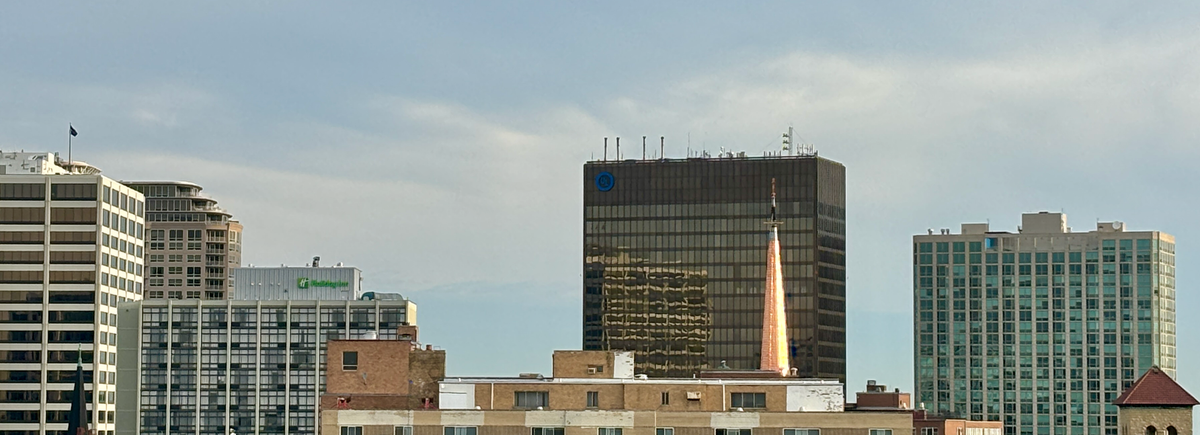
A couple of blocks away from my home is a church that has a spire atop it. The spire reaches 10 or 12 stories. In the past several weeks we've been watching the renovation of that spire.
Two guys, removing old panels piece by piece, replacing them with gleaming new bronze panels. All while hanging from a rope. Or standing on a platform 12 stories up, tethered to some anchor that (to my eye) is ridiculously perilous. Apparently not so much to the workers. One sat to take a break and dangled his legs over the platform like it was a dock on some placid lake.
Amazing craftwork under difficult conditions.
It occurs to me that doing this difficult work is a really good example of a complicated problem. There are known ways to go about it that generate the expected outcome of getting the craft right while the workers remain safe. Yes it takes human skill, but the reality is that it depends (mostly) on doing things using specific protocols and steps that are based on folks solving the puzzle of doing craft work at ridiculous heights.
I am sure there is a lot of innovation among steeplejacks and the way they do their work, and expert improvisation as they confront each new project. Overall, however, I'd argue that there is a narrow band of "right" ways to do things. That's what makes a complicated problem. It is a puzzle. There are right ways to go about solving it.
I write this because I've been thinking about a recent conversation I had and why it did not sit well with me. And I think it gets back to my understanding of complex vs. complicated challenges.
The conversation took place at a gathering of folks involved with addressing climate change challenges in Evanston (including equity).
The conversation was about the city government's persistent shortfall implementing policies and practices that address known gaps ensuring that Evanstonians across the city benefit from the same environmental assets and are exposed to similar environmental risks (the foundations of environmental equity). The topic came up in relation to the apparent lack of energy and progress around recommendations made by a year-long city effort - the Environmental Equity Investigation (EEI) - to document and repair environmental equity.
"What are the blockers?" someone asked, referencing the Agile process meaning of blockers: a critical issue that stops a team from progressing on its path to a desired outcome. Aside from the fact that 4 of the 5 folks in the conversation did not know the specific reference, the basic framing of the challenge, to me, was off.
I sensed it assumes that the challenge is a complicated problem. Maybe it's very complicated, like doing craft work at ridiculous heights. But complicated nonetheless. Find the right pieces of the puzzle to solve and you get your outcome.
One of the conversation participants, a civil rights elder who has deep experience working with city staff over many years, suggested the challenge is rooted in all the nuanced factors that make racial equity a persistent, never-ending issue. That's a complex challenge. There are many possible right things to do to move the outcomes in the desired direction, but it is not a puzzle to be solved by identifying a handful of blockers and removing them.
Might the city staff improve the way they incorporate equity into budget and program decisions? Of course.
Might the top ranks of city staff be more effective leaders on equity goals? Yes again.
Does the city government face a swarm of issues, challenging its ability to focus attention and often leading to difficult trade offs? Maybe more so in today's political environment.
Might the white community of Evanston be more effective advocates for equity? We often see the community get highly energized about the height of downtown developments, or single family zoning rules, or saving a historic property. Where is this level of energy for equity?
And so on. Many possible factors to address and each - if addressed - creates some new condition that changes the landscape. Complex, continuous challenges evolve as we try to address them.
EEI recommendations are a perfect example. The effort resulted in 31 specific recommendations, covering such issues as open spaces and parks, transportation, housing and community services. I've written in previous posts about how these recommendations are best viewed as free-floating solution ideas. They are all good, but they are a snapshot in time and do not constitute a strategic framework for the long-term outcome of having a community with more equitable environmental assets and protections.
The team behind the EEI effort clearly recognized this. In the final report, they write:
“While the investigation offers an important baseline for understanding environmental disparities in Evanston, its findings are shaped by data availability, study scope, and timing. Ongoing data collection, community engagement, and city leadership buy-in will be necessary to refine and expand upon these insights over time.” (EEI final report, p20 - emphasis mine)
The pattern I see, however, is one where we fall into the trap of focusing entirely on implementing the actions outlined in a legitimately good effort, but not balancing this with the need to keep learning, listening and adapting as we do the work.
Maybe I am being too harsh. We do need to find the blockers and have methods to sniff them out. We all need a little bit of that steeplejack in us, doing difficult craft work, on a rope, 12 stories up.
But then we need to get ready to climb up that next spire and do it again, and again.
The photographs which accompany these posts are taken by me, and show different settings and views of Evanston (where I live). It is a visual reminder that this is the most important setting for belonging and contributing to community: our neighborhoods, our cities.
Jeff Merrell - Community Listening © 2026 by Jeff Merrell is licensed under CC BY-NC 4.0